President Donald Trump’s 2026 State of the Union address, delivered Feb. 24, made waves through the nation with a declarative demonstration and a vision for what is to come for America and the world. For many, the speech was a complex mix of ambition, grandiose and tension. While the address served as a recollection of the administration’s successes and future plans, the public had varied opinions on the showcase.
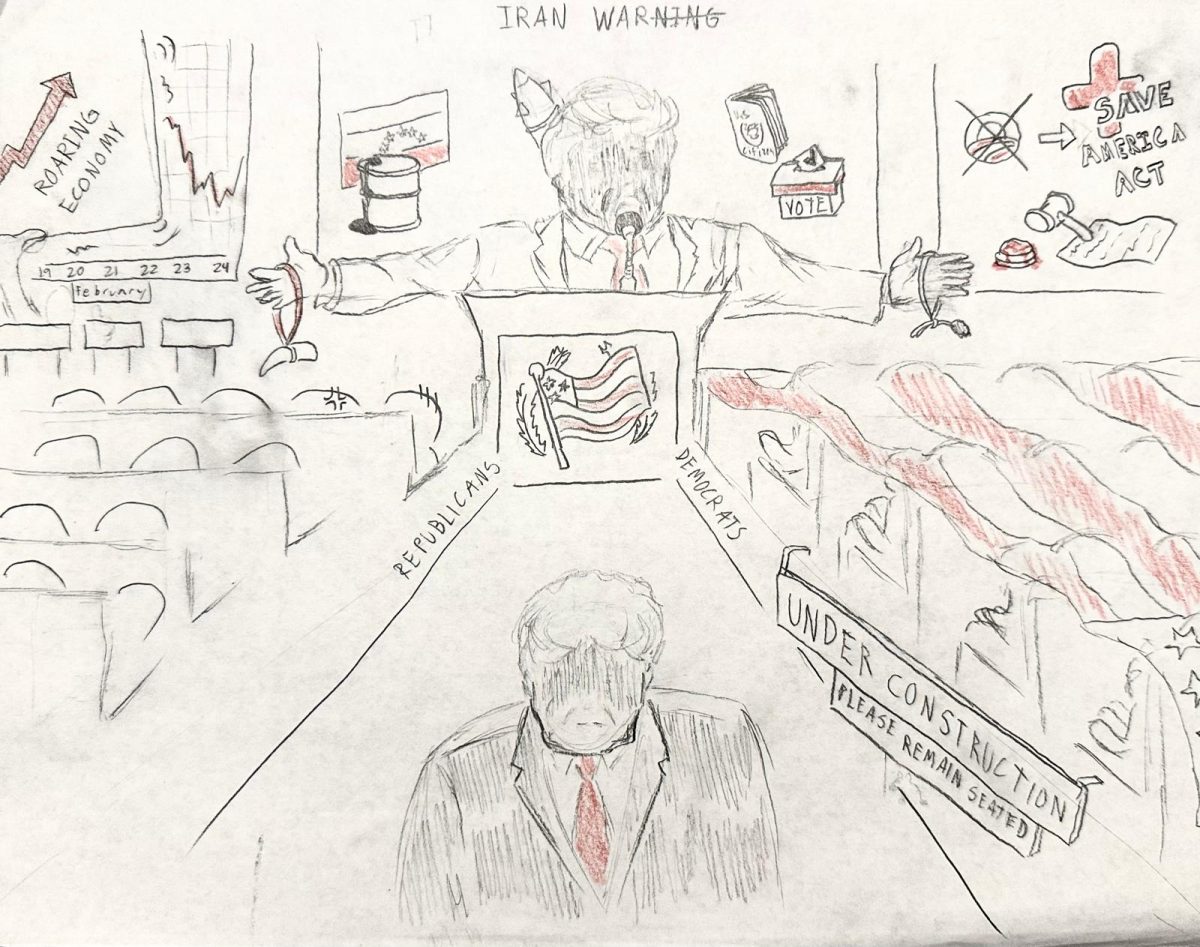
The President’s address, that reminded United States citizens of the upcoming 250th anniversary of the U.S. creation, illustrated immense pride due to economic prosperity. With a focus on the growing stock market and decreased inflation rate of 1.7%, the administration painted a period of prolonged accomplishment. The product, a bigger, better, roaring economy, was a consistently mentioned point of interest.
For some students, the economic optimism was definitely something the U.S. needed to hear during these tough times; however, others believe that there is still work to be done and underlying reasoning that must not be ignored.
“The address speaks for itself… whenever the president boasted about the positive state of the economy, the room would erupt, cheer or clap. For me, the market’s resurgence and plummeted inflation were extremely important. However, the state of other economic sectors is still in desperate need of fixing. The start of this administration put them in the situation where they had to climb back, which is another reason I take this whole speech with a grain of salt,” junior Lucas Galindez said.
Following the economic section, new initiatives and legislative goals were introduced. Among them, the War on Fraud initiative garnered a lot of talk. Led by Vice President James David Vance, the program aims to investigate alleged government waste and fraud, particularly targeting states like California and Massachusetts. Discourse about the new implementation led to speculation about the real motives.
“The idea of attempting to stop government waste and fraud is great—everyone should back that. But the real problem for me, and why I think the initiative is suspicious, are the two states being targeted. I believe there is political bias in their choice to take on such a process. The two states have openly been against the administration, which is the reason for my suspicions,” junior Camilo Arriola said.
Once the president moved on from this topic, foreign policy achievements were the next theme. He celebrated the capture of Nicolas Maduro and declared Venezuela a new friend and partner. The millions of barrels of oil coming to the U.S. was evidence enough for this, at least as Trump believes. However, the conversation shifted from the friendly foreign situation to a much more tense tone when he began to address Iran. Asserting that the U.S. had already obliterated the country’s nuclear program, the president warned of an imminent Iranian threat—one that had been building up its arsenal against the wishes of the U.S.
“The whole foreign approach, either regarding Venezuela, Europe or Iran, is one that I believe is trying to project strength. I think it is highly important for the people of the U.S. to consider if the actions being taken against such countries is a necessity, as the president treats it, or something more of choice,” junior Alessandro Frutos said.
A significant portion of the speech was dedicated to future promises. Of those proposals, one regarding healthcare stood out. The president cemented his position on the Affordable Care Act and his objective of replacing it with the Great American Health Plan. This would provide direct subsidies, and, to alleviate the hostile approach, he followed it up by proposing an 1,000 dollar federal help for individual retirement contributions.
“The promise of a new healthcare plan sounds interesting and, since it will directly affect my generation, it’s very important to know what he plans to do. Although, I think we need to take everything into account… like how this will affect things as they are now. Who is this going to primarily benefit and are there other motives behind all the greatness?” junior David Perez said.
Continuing the pattern, the president went on to speak of something else that would oppose the previous democratic positions and legislative approaches. The Delilah Law would prohibit states from issuing commercial driver’s licenses to undocumented immigrants. He then tied it to the urgency of passing the SAVE America Act, which would require proof of citizenship for voting and would ban most mail-in ballots. As seen, the President’s stance on immigration and elections remains one of his most important and redundant messages.
The address finally concluded after an hour and forty-seven minutes, breaking Bill Clinton’s record for the longest State of the Union address in 2000 by almost twenty minutes. The ceremonial honors, including the Presidential Medal of Freedom for the U.S. men’s Olympic hockey team and a Congressional Medal of Honor for the 100-year old Navy veteran Royce Williams, were meant to re-invoke national pride.
In the democratic response, Virginia Gov. Abigail Spanberger focused on countering the president’s economic boasting, claiming that people continue to suffer and struggle. But this was not the only action against the president. Texas Rep. Al Green was forcibly escorted because he had a sign that read “Black people aren’t apes” in response to a video Trump had posted on social media mocking the Obamas by using artificial intelligence to crop their faces onto apes.
Green was not alone in this, as many protested the U.S. Immigrants and Custom Enforcement operation in Minneapolis. Minnesota Rep. Ilhan Omar shouted “You have killed Americans,” and California Rep. Norma Torres held photographs of the two victims. Omar later walked out early with several others doing the same. Many democratically affiliated people wore blue pins that read “Stand with Survivors, Release the Files” in an attempt to further pressure the administration into releasing all Jeffrey Epstein related files.
One of the most controversial moments was when the president prompted people to stand up if they agree with the statement that the first duty of the American government is to protect American citizens, not illegal aliens. When the Democrats remained seated, Trump pointed them out, saying they should be ashamed of themselves.
Ultimately, the 2026 State of the Union address was delivered as a long and clear reflection of the current political and social state of the U.S. In line with the purpose of the speech, Trump targeted key topics that many believe are currently shaping the public opinion towards the presidency that are said to impact November’s retention election.